ChatGPT UPI Spending Analysis: Does It Actually Work?

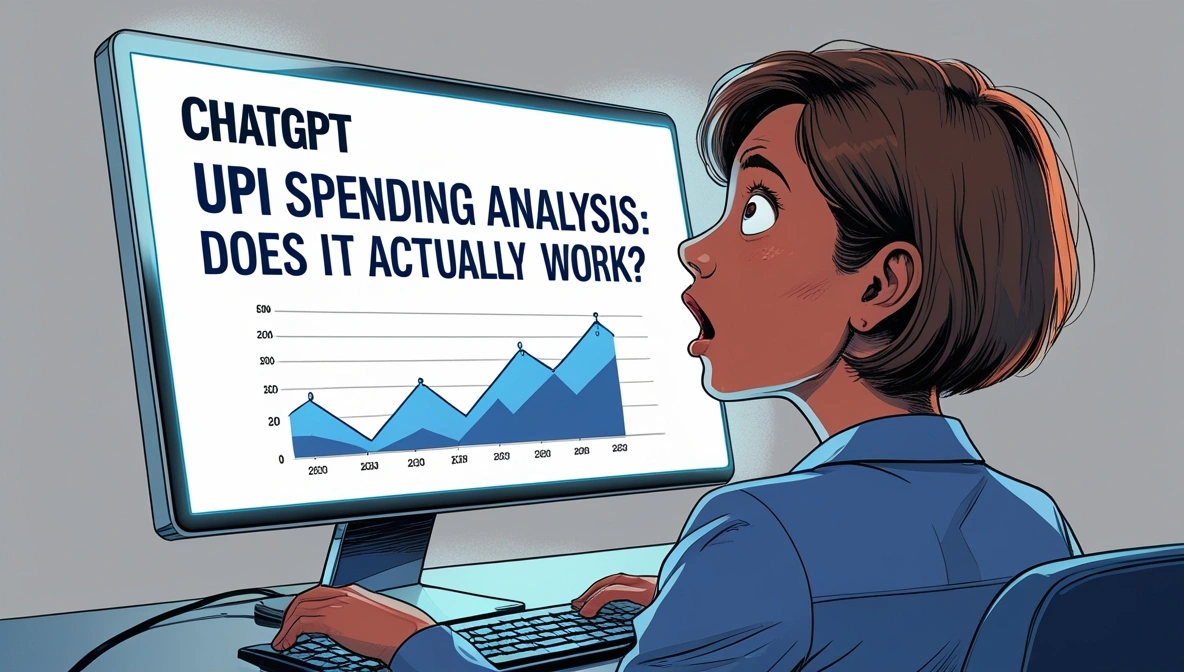
Most of us generally know where our money goes every month – that food delivery once in a while, perhaps a couple of weekends out, and the one subscription everyone vaguely remembers signing up to, nobody really knowing what for. Yet, that “general” knowledge seems to be covering up something really significant; the fact that when people actually go ahead and run a decent UPI spending analysis, it almost always looks different from what they predicted.
That is precisely what we are witnessing currently – with people from all over India exporting their UPI transaction history and dumping it on ChatGPT to sort through a few months of sheer financial madness. Some find themselves pleasantly surprised, others find that the analysis is too vague for them to take any action on it, and a few end up realizing that the AI has, quite boldly, gotten it wrong.
We are going to cover everything in this blog: the working of UPI spending analysis on ChatGPT, the step-by-step breakdown of the whole process, where it has rightfully earned its reputation, and where it quite obviously falls short. If you have been planning on running your own UPI spending analysis using the AI, then this is the unbiased analysis you need.
So What is UPI Spending Analysis- and Why Should You Care?
UPI spending analysis is about turning the raw UPI transaction data-every Swiggy order, every cab ride, every rent transfer-into a true reflection of your spending habits.
India transacts more than 13 billion UPI transactions per month. Only a fraction of users ever go back and look at it. The scrollable history in PhonePe isn’t going to tell you that food delivery has stealthily eaten up 24% of your take-home pay this past quarter; the bank statement showing a column of debits is certainly not going to clue you in that weekend spending averages nearly three times the weekday average.
UPI spending analysis is designed to fill that blind spot. ChatGPT, without really being a financial product in the first place, is proving to be an extremely powerful additional layer on top of this data, but there are some important limitations.
It’s not a matter of lacking data; every transaction is tracked. The issue is that almost nobody actually uses it in a meaningful way.
The Process of Doing a ChatGPT UPI Spending Analysis, step-by-step
It takes you about 15 minutes for the very first time. The detailed explanation is below.
Step 1 – Export your transaction data
- Google Pay: Go to your profile > Manage your Google account > Request data export> Export using Google Takeout. The transaction history is in the CSV format.
- PhonePe: Go to ‘Transaction History’ and use the download facility in the application.
- Bank UPI statement: Login to your net banking portal. All the top banks (HDFC, SBI, ICICI, Axis, etc.) give an option to download your UPI statement
Step 2 – Strip out sensitive information
Remove all the data below from your transactions before pasting it in ChatGPT.
- Complete account and IFSC numbers
- Full names of individuals in case of personal transfers.
- Transaction reference numbers other than the last 4 digits.
- The merchants, amounts, dates, and transaction type are the only data ChatGPT needs.
Step 3 – Prompt accurately
Your UPI spending analysis results are only as good as the questions that you ask. If you ask a general question, you will receive general answers.
For example, instead of asking: “Analyze my expenses.”
Try asking one of the following:
- “Categorize my transactions into food, transport, groceries, subscriptions, and others. Also, give me a total in each category.”
- “Which week had the highest expenditure, and which transactions contributed to it?”
- “Analyze my food delivery transactions for the last 3 months. Did my expenditure increase or decrease over these months?”
Step 4 – Ask follow-up questions
You don’t get the best results right away; they come with time and multiple interactions. You can ask questions such as, “I think you are mistaken in the categorization of some food transactions,” and “What is the percentage expenditure on weekdays vs weekends?” ChatGPT is able to process follow-up questions.
What ChatGPT Gets Right About UPI Data
Messy transaction names, sorted efficiently.
UPI labels are an aesthetic nightmare: ZOMATOORD8763, UPI/P2M/QRCODE/987, PAYTMMERCHANT*1234 are the average fare, and taking a human the better part of an afternoon would be needed to sort 300 transactions properly. ChatGPT groups it into reasonable categories within under a minute.
For ‘clean’ CSV data, it hits around 80-85% accuracy-this may not sound great, but for a task that, even manually done once, would require a full afternoon to organize, I found it superior, especially considering it flags down only the broad spending patterns that matter.
Finding overlooked expenditures:
I think this is where ChatGPT adds the most value-it’s just not about finding a piece of information, and it doesn’t even involve searching for data in itself.
Reviewing three months of UPI data properly allows us to find:
- Monthly subscription costs that we continue to pay for apps that we do not actively use.
- Double what one thought one would spend each month on ride-sharing.
- Where grocery expenses overlap food costs in ways one cannot usually connect.
These can be found simply by reviewing spending history without having to do extra searching.
Comparing months to one another:
If you compare two or three months’ worth of data at once, the data provided is significantly more useful: “my December take-out spending was 40% higher than any prior month’s take-out spending” offers a better picture than “I spent more money this December than the previous month’s spending”.
Where it all goes wrong
Messy Merchant Names Make categorization hard
The UPI statement generated by the banks is messy. The same transaction from Swiggy may show up as ‘SWIGGY’, ‘BUNDL TECHNOLOGIES’, ‘UPI/P2M/SWIGGY/FOOD’. ChatGPT will decide on the categorization, but will not make any mention if it isn’t sure about the name it processed. A seemingly accurate result may hide quite a bit of miscategorization.
Peer-to-peer transfers, a black box
This is the major structural drawback of any UPI spending analysis conducted by ChatGPT. P2P transactions, i.e. Money sent to friends, families, or roommates, come under this head, showing the transaction amount along with a recipient’s name. The AI has absolutely no information regarding the intent of sending the 8000 rupees to Priya. Is it a rent payment, is it a loan to her, or is it to settle a bill for her birthday party? ChatGPT will take a guess, and sometimes it will be right and sometimes wrong.
No memory across chats
As soon as you close the chat, the entered data is lost forever. The analysis will reset every month. There will be no comparison, no automatic upkeep, nothing. This is fine if it’s a one-time thorough analysis. But if you’re looking to track finances regularly, this becomes a drawback.
Confidently wrong results are as confident as correctly made results
This is perhaps the most vital factor to grasp about using AI for UPI spending analysis: there’s no indication whether a wrong result was made instead of a correct one. There’s no confidence metric. No hint that says “I might have got these 12 results wrong”. If you don’t check manually, it is easy to proceed on false information.
FAQs
Q1. Can I safely share my UPI transaction history with ChatGPT?
You can do so with care. Ensure ‘chat history & training’ is turned OFF in your settings, and delete names of people you transferred to, and account numbers of both the sender and receiver, before pasting.
Q2. Will ChatGPT connect directly to my PhonePe/Google Pay?
No. ChatGPT will not have access to the live data of any UPI or bank application. All transaction history needs to be extracted and pasted by you.
Q3. How accurately will ChatGPT categorize UPI spending?
It should get about 80-85% accuracy with clean CSV files. Merchant names might be messed up, and peer transfers might be wrongly categorized. Always check your top 2-3 categories manually.
Q4. Is ChatGPT better than a budgeting app?
It’s an entirely different use case. Budgeting apps are best for constant tracking, whereas ChatGPT can be excellent for a one-time audit for a certain time frame.
Q5. What’s the best prompt I can give ChatGPT to start analyzing my UPI transactions?
Use a prompt such as: ‘Analyze the transactions below into the following categories: Food, Transport, Groceries, subscriptions, and ‘other’. Show me the total value spent in each category. Also, highlight any spending that seems out of the ordinary.
Conclusion
UPI spending with ChatGPT lands on an honest-and-useful median, not better than not doing it at all, and not as accurate as the ideal connected budgeting app. Yet for the vast majority of people who haven’t really parsed through their transaction data in any organized fashion before, a 15-minute conversation is likely to be surprisingly revealing, about mistaken estimates of total spending for a month, unnoticed recurring subscriptions, or particular weeks where spending has unexpectedly spiked due to particular events.
For many, this alone is enough to experiment with. The trick is not to take any of the results at face value but to treat them as the hypothesis. Do a fact check on your high-value data. Don’t take the AI’s word for it when it’s wrong. Go into it with eyes wide open to the fact that P2P transfers and jumbled merchant entries will leave holes in the analysis. But used that way, UPI spending analysis with ChatGPT ceases to be a parlor trick and becomes a true first step in really understanding where your money goes, as opposed to where you think your money goes.
Shruti Singh is a passionate writer having 6 years of writing and editing experience. Through her articles on news2world, she explores the connection between people, planet, and everyday choices, translating complex information and issues into clear, engaging, and practical insights. Her work aims to inspire readers to adopt eco-friendly habits, think critically, and contribute meaningfully to a more comfortable future.