


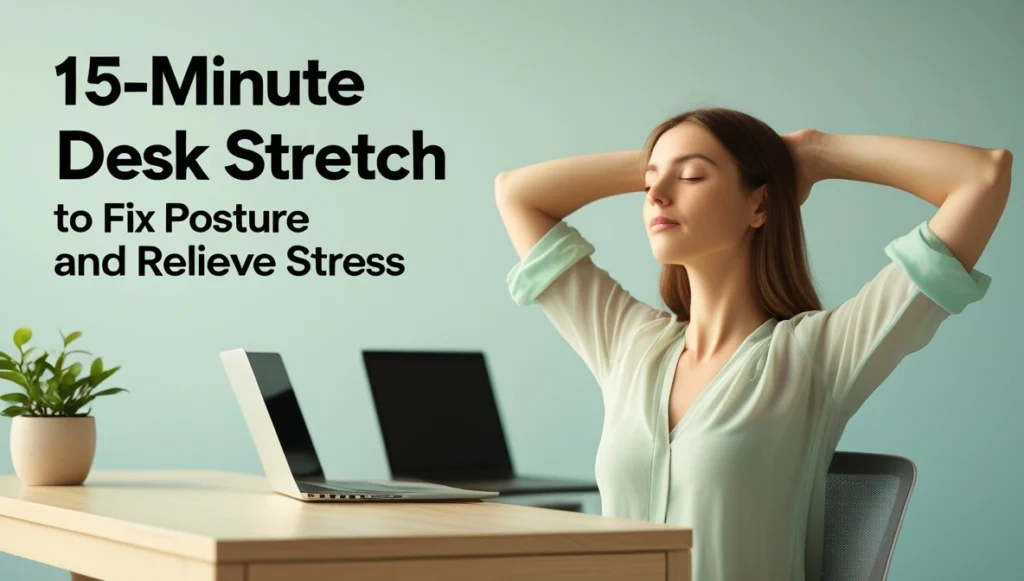
If you spend long hours at a desk, your body is silently adapting—and not in a good way. Poor posture, stiff neck, back pain, and mental fatigue are all consequences of prolonged sitting.
Research shows that office workers spend over 80% of their working time sitting, which significantly increases the risk of musculoskeletal problems and chronic discomfort .
That’s where a desk stretch routine for posture becomes essential.
In just 15 minutes a day, you can:
- Reset your posture
- Reduce stress
- Improve blood circulation
- Boost focus and energy
This guide gives you a simple, structured routine you can follow without leaving your chair.
Why a Desk Stretch Routine for Posture Works
Your body is designed for movement—not for sitting 8–10 hours a day.
When you sit continuously:
- Muscles tighten (especially neck, shoulders, hips)
- Spine alignment shifts forward
- Blood circulation slows down
Studies show that regular stretching and ergonomic changes can significantly reduce neck pain and improve posture alignment.
Even small movements matter. According to health experts, stretching for 1–2 minutes every 20–30 minutes improves circulation and reduces stiffness.
That means your 15-minute routine can completely transform your daily health.
The 15-Minute Desk Stretch Routine for Posture (Step-by-Step)
This routine is designed to target all major problem areas caused by desk work.
Total Time: 15 Minutes
- Neck & shoulders: 5 minutes
- Spine & back: 5 minutes
- Lower body: 5 minutes
1. Neck Stretch (2 Minutes)
Your neck carries the most strain due to screen time.
How to do it:
- Sit upright
- Tilt your head to one side
- Hold for 15–20 seconds
- Repeat on both sides
Why it works:
This relieves tension caused by “forward head posture,” a common issue in desk workers.
2. Shoulder Rolls (1 Minute)
Shoulders tighten due to typing and mouse usage.
Steps:
- Roll shoulders forward 10 times
- Roll backward 10 times
Benefit:
Improves mobility and reduces stiffness. Simple movements like shoulder rotations can relieve tension without interrupting workflow.
3. Seated Spinal Twist (2 Minutes)
This stretch resets your spine alignment.
Steps:
- Sit straight
- Twist your torso to one side
- Hold for 15–20 seconds
- Repeat on the other side
Why it matters:
Spinal twists improve flexibility and reduce lower back stress.
4. Chest Opener Stretch (2 Minutes)
Desk work causes rounded shoulders.
Steps:
- Interlock fingers behind your back
- Pull shoulders back
- Lift chest upward
Benefit:
Opens the chest and reverses slouching posture.
5. Wrist & Finger Stretch (1 Minute)
Typing causes micro-stress in wrists.
Steps:
- Extend one arm
- Pull fingers back gently
- Hold for 10–15 seconds
Benefit:
Prevents strain and improves flexibility.
6. Seated Leg Extension (2 Minutes)
Lower body often gets ignored.
Steps:
- Extend one leg straight
- Hold for 10 seconds
- Alternate
Why it works:
Improves circulation and reduces stiffness in legs.
7. Hamstring Stretch (2 Minutes)
Tight hamstrings contribute to poor posture.
Steps:
- Sit at the edge of chair
- Extend one leg
- Reach toward your toes
Benefit:
Improves flexibility and reduces lower back strain.
8. Deep Breathing + Posture Reset (3 Minutes)
Finish your routine by resetting your posture.
Steps:
- Sit upright
- Inhale deeply for 4 seconds
- Exhale slowly
Why this is powerful:
Stretching combined with breathing reduces stress and improves mental clarity. It also helps maintain balanced body alignment, which is key to good posture.
How Often Should You Follow This Routine?
For best results:
- Every 2–3 hours during work
- At least 2–3 times daily
Experts recommend combining stretching with movement breaks to prevent long-term health risks like cardiovascular issues and metabolic disorders.
Benefits of a Desk Stretch Routine for Posture
If done consistently, this routine delivers measurable results.
Physical Benefits
- Reduces neck and back pain
- Improves flexibility
- Enhances posture alignment
Mental Benefits
- Reduces stress levels
- Improves focus
- Boosts energy
A 12-week workplace stretching program has been shown to significantly improve quality of life and reduce discomfort in desk workers.
Common Mistakes to Avoid
Even simple routines can fail if done incorrectly.
Avoid:
- Holding your breath
- Overstretching
- Skipping consistency
- Ignoring posture while sitting
Remember: Small, consistent effort beats occasional intense workouts.
Pro Tips to Maximize Results
- Follow the 20-8-2 rule: Sit 20 mins, stand 8 mins, stretch 2 mins
- Keep your screen at eye level
- Use lumbar support
- Set reminders for movement
Conclusion: Desk Stretch Routine for Posture Is a Daily Necessity
You don’t need a gym.
You don’t need equipment.
You just need 15 minutes.
Consistent stretching helps you:
- Fix posture
- Reduce stress
- Improve productivity
If you start today and stay consistent, your body will thank you in weeks—not years. A desk stretch routine for posture is no longer optional—it’s essential in today’s sedentary lifestyle. So take a break, stretch your body, and reset your posture—because small daily habits create long-term health.


Shruti Singh is a passionate writer having 6 years of writing and editing experience. Through her articles on news2world, she explores the connection between people, planet, and everyday choices, translating complex information and issues into clear, engaging, and practical insights. Her work aims to inspire readers to adopt eco-friendly habits, think critically, and contribute meaningfully to a more comfortable future.


