


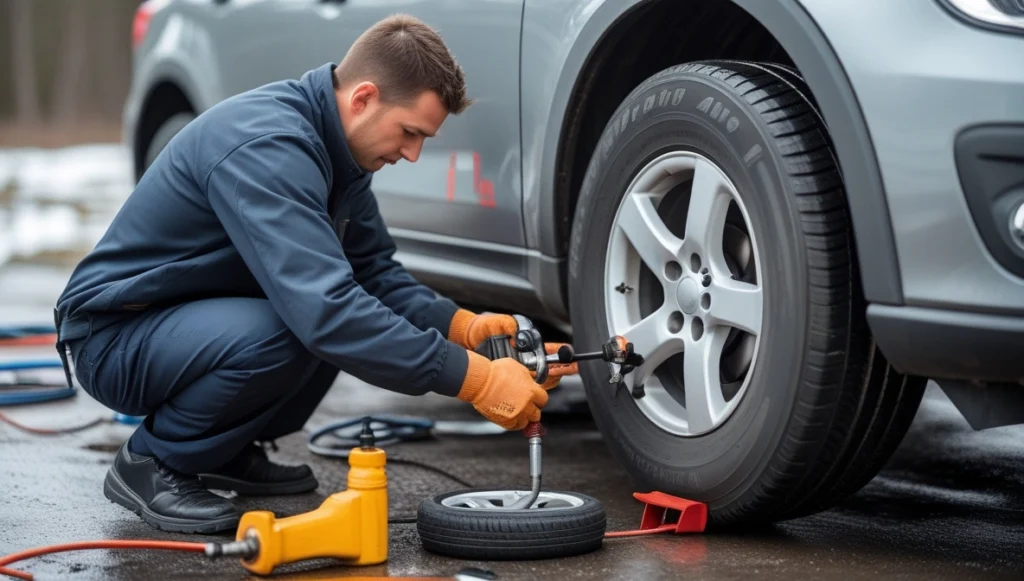
Because having a tire blow out can be a terrifying experience, you should make sure that you are in a secure location and that you are in a calm state before you follow our instructions on how to change a tire. The first thing to keep in mind is that you should never attempt to change a tire if your personal safety is in risk or if you do not possess the appropriate tools.
If, on the other hand, you are in a secure location, armed with the appropriate tools, and have the self-assurance to change the wheel, then the good news is that a spare wheel is the most dependable option to get yourself back on the road.
Your automobile can come with either a full-size spare tire or a tiny space-saving spare tire. The process of changing a wheel, on the other hand, is the same overall. Are you someone who prefers to handle routine car repairs on their own? If so, then being able to change the tires on a vehicle should be among your primary skills. The ability to change tyres is, nevertheless, a valuable life skill in and of itself. Learning how to change a tire is useful for several reasons,
- Your vehicle has a flat tire and you’re stuck in a no-service zone.
- Waiting for assistance is not an option since you are in a perilous position, or
- If you’ve been planning a long journey, a flat tire could ruin it.
This blog post serves as a comprehensive guide on how to change a car tire on your own, whether you’re at home or on the go.
Bringing the vehicle to a halt in order to replace a flat tire
As soon as you become aware of a flat, you should gradually press down on the accelerator, turn on your hazard lights, and search for a level area that is away from the traffic that is approaching. In the event that you are driving on a highway that is crowded with vehicles or on terrain that is mountainous, allow other drivers to pass you by.
After you have stopped, check to see that the area is level and stable. When the jack is set, grassy and soft dirt surfaces have a tendency to sink beneath the weight of the car. Put the parking brake (also known as the hand brake) on and turn off the vehicle.
The necessary equipment for changing a tire
The task of changing a car’s tire is not beyond the world of science, and all that is required to complete the work is a few fundamental tools.
- The term “car jack” refers to a tool that is typically present in the spare wheel well of your vehicle, which is located in the trunk of your vehicle.
- The lug wrench can also be found in a separate compartment or the automobile jack itself.
- Tire spare: It goes without saying that in order to repair the flat tire, you will need a spare tire that has been properly inflated.
In addition, you may be sure to bring a few additional tools that might come in handy throughout the process of changing tires.
- A candle or light
- Welds for Wheels
- Warning signs that reflect light
- Canned air
- Protective gloves
Instructions on how to change a tire in a number of steps
Knowing how to change a tire is a valuable life skill. It can help you handle emergencies independently and avoid long delays. Here are some common situations where this knowledge becomes essential:
First, locate a safe spot that is not congested with vehicles
Make sure you’re in a safe area before you attempt to change a flat tire. Avoid traffic as much as you can. The ideal option, if available, would be a flat.
Make sure your spare tire is properly inflated
As soon as you’ve reached a secure area, you should check the spare tire’s inflation pressure. If you want to know how much air to put into your spare tire, look in your owner’s handbook or on the sign beside the driver’s side door jamb. To make sure your spare tire is ready to go in the event of an emergency, check its inflation pressure at least once a month in addition to your other tires.
Take off the wheel covers if your wheels are steel
The wheel cover can be removed using a flathead screwdriver, similar to opening a paint can. There are several cars that have a pry bar and socket in one.
Lock your car and remove the wheel nuts. Then, get your spare tire.
You must ensure the vehicle’s stability before raising it. Put your vehicle in park if it has an automatic gearbox, press the brakes to stop, and then turn off the engine. Put your car in first gear if you’re going level or uphill, and in reverse if you’re going downhill. Then, put the parking brake on and turn off the engine if your car has a manual transmission. The next step is to use bricks, pebbles, or wood to block your wheels on the side of the vehicle opposite the flat tire. It is crucial that you follow all of these measures to ensure that your vehicle does not roll. After that, get a lug wrench. In movies and TV shows, the instrument used to change a flat is often fashioned like a cross or an L. As you crank the lug wrench counterclockwise, use the “lefty-loosey, righty-tighty” technique to loosen the wheel nuts.
Hoist your car onto the jack.
Follow the directions on your owner’s manual for the proper placement of the jack. Put the handle on your hydraulic jack and get ready to pump it up and down. To make it easier on yourself, lower it to its lowest setting and repeat; the jack will handle the rest. Insert the wrench or rod into the scissor jack and turn the crank clockwise to raise the vehicle.
Take the flat tire off
Remove the loose wheel nuts by hand. Next, grab the tire’s sides and bring it closer to you using both hands. It should come loose from your car by sliding along the lug bolts. Move the tire to the rear of your car by rolling it.
Change the wheel nuts once you’ve lifted the spare onto the lug bolts.
Because, you know, tires are hefty, this part can be a bit of a challenge. To secure the spare tire to the lug nuts, you may need to try lifting it a few times. Lower your car only after you have replaced and snugged all wheel nuts. To keep the wheel in the middle, tighten the nuts in a star pattern. After you’ve put the wheels in place, use the wrench to fasten the nuts, but don’t overtighten them.
Bring the car down and secure the wheel bolts.
When lowering your car, be sure to follow the manufacturer’s directions. Loosen the release valve of your hydraulic jack slowly in order to lower your vehicle. Turn the wrench or rod counterclockwise to lower the vehicle if you have a scissor jack. Use the lug wrench to secure the wheel nuts while your car is parked on the ground. To determine the correct tightness, consult your owner’s manual.
If your wheels are steel and you have a wheel cover, replace it.
Reinsert the wheel cover using your hands. For this stage, it’s better not to use a hammer, wrench, or anything else that can cause damage. You risk damaging or denting your wheel cover.
Well done! The last step is to put the flat tire in your trunk and drive to the closest Cooper Tire store. They can assess the apartment and determine if it is repairable.
Conclusion
Learning how to change a tire is a real talent that needs to be picked up with every incentive. It gives you the ability to deal with contingencies independently and minimizes disruption to your travel plans. Although the system may seem intimidating at first, it becomes a reliable way to inform and practice.
Preparation is as important as execution. Knowing where the equipment is, knowing the layout of your vehicle, and staying calm under pressure makes all the difference. When you encounter a flat tire, you’re not stuck wondering what to do—you’re ready to handle it in an efficient and appropriate way.


Shruti Singh is a passionate writer having 6 years of writing and editing experience. Through her articles on news2world, she explores the connection between people, planet, and everyday choices, translating complex information and issues into clear, engaging, and practical insights. Her work aims to inspire readers to adopt eco-friendly habits, think critically, and contribute meaningfully to a more comfortable future.


