


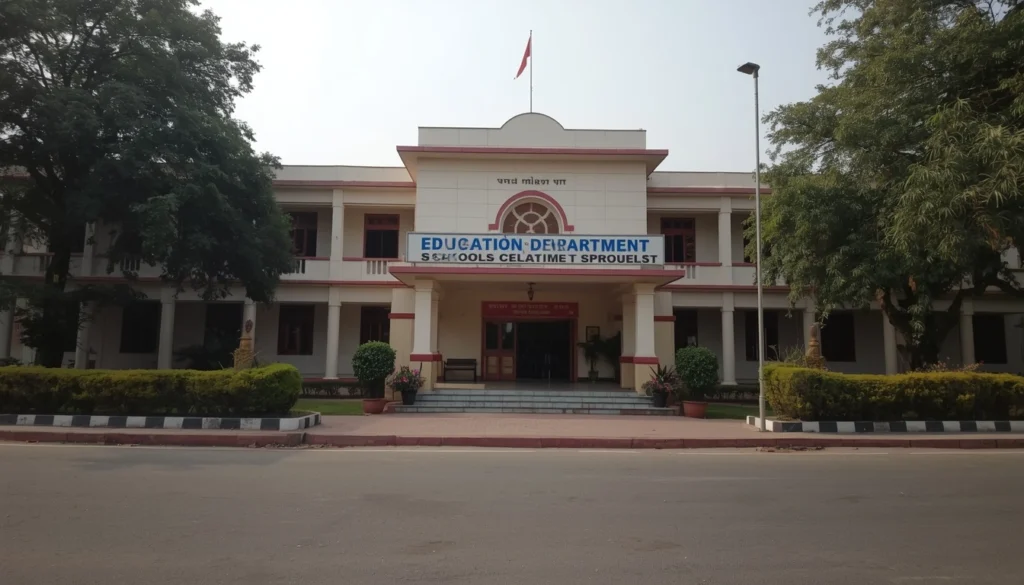
Education Department Bihar stands as one of the largest education administrative bodies in India, overseeing millions of students across thousands of government schools. This sheer scale of responsibility is vast; teachers need to be recruited, curriculum delivered, infrastructure built, and dropouts curbed. Scaling any intervention to the scale required for education management inevitably necessitates sustained policy actions, continuous field presence, and information-backed decision-making.
Bihar’s story is particularly important in light of the long road already travelled and yet to be traversed. The Education Department Bihar functions in a state with a diversity in socioeconomic background, spread across diverse geographical terrain, coupled with learning deficits between genders, requiring distinct solutions. As a result, comprehending how the system functions – its structure, priorities, current reform efforts, and actual outcomes – gives a deeper perspective of the state of school education in Bihar.
Size of the school education sector in Bihar
Bihar has one of the largest government school systems in the country, so it is unsurprising that the sheer scale is astronomical:
- More than 70,000 schools operate at the government level
- The student population figures are in crores and encompass primary, upper primary, and secondary segments
- A large proportion of students are from lower income segments, making government schools the only viable alternative, if any
- A major issue remains the student-teacher ratio, particularly in the remote rural blocks
- While girls’ enrollment has improved, retention up to the secondary level is still an area for concern
Also, the geographic coverage is immense – from Patna to rural blocks within Kosi and Seemanchal – and uniformity of quality delivery becomes problematic from structural grounds.
How the Department organizes school administration
The education department bihar runs through a multi-level administrative set up to ensure accountability reaches down to the district and block level.
State Level
- The Department of Education plans the state-level policy, approves the budget and reviews performance at the state level.
- Bihar Education Project Council (BEPC) manages the implementation of centrally sponsored schemes like the Samagra Shiksha scheme.
- State uses UDISE(Unified District Information system for Education) to collect data about schools such as attendance and infrastructure available in each school.
District and Block Level
- District Education Officers (DEOs) are responsible for managing all the schools in the district.
- Block Education Officers (BEOs) have the job of visiting schools in the block and reporting attendance and ground realities.
- This way, a direct channel is established from performance in the classroom to policy decisions at the state level.
School Management committees (SMCs)
Every govt school has a School Management Committee consisting of parents and community members, which has control over local funds and infrastructural choices of a particular school and influences the day-to-day functioning of a school positively.
Key areas where Bihar schools are changing
There are a number of key areas of focus of the education department bihar where intervention of long-term perspective is already being manifested.
Enrolment and Retention
The number of out-of-school children who have been successfully brought into the education system through specific enrolment drives has been substantial. Interventions like mid-day meals, free uniforms, and the cycle scheme for girl children help in retaining children in the schools. Despite all this, girl child dropout in the secondary stage has to be addressed through collaborative measures, as there is no easy way to tackle this problem just by policies.
Infrastructure Development
The number of classrooms and the availability of water and toilets in all the government schools have increased. Availability of separate toilets for girls has played a direct role in bringing and retaining girl children in the schools. Despite such an overall change, there is a huge difference in the quality of infrastructure between schools in urban and rural areas.
Teacher Recruitment and Training
Mass recruitment of teachers has led to plugging of many vacancies in the system. In-service training is regularly provided for all the teachers to help them with pedagogical best practices in classrooms, and for that matter, with primary learning outcomes and foundational literacy and numeracy. Digital learning and pedagogy are now an integral part of teacher training programs.
How Data Influences Education Policy in Bihar
The increasing usage of data to influence policy is another major development in the workings of Education Department Bihar:
- UDISE data gives a snapshot of every school each year, covering student enrollment, school infrastructure, number of teachers, and students’ learning outcomes
- Budget allocation uses this data – the worst performing districts (in terms of dropout or infrastructure quality) are prioritized and receive special support
- Learning outcome evaluations provide evidence for what needs to be done to deliver the curriculum more effectively and to train teachers better
- Accessible data brings more accountability – Civil society organizations, the media, and academia rely on data to make their own assessments of progress.
Conclusion
The Bihar Department of Education has taken up a difficult education problem, among the hardest in India, and it is progressing-on uneven, but demonstrably. Enrollment has increased, buildings have been renovated, and systems for tracking data have been honed. These are not minor victories in this enormous task. The true hurdle, however, lies in educational outcomes. Opening school doors is the initial task. It remains to be proven that every child who steps through a Bihar government schoolhouse can read, compute, and reason by the time he walks out.
FAQs
1. How many government schools are in Bihar?
There are more than 70 thousand government schools of 3 stages – primary, upper primary & secondary level, which are dispersed throughout the state.
2. What is BEPC?
The Bihar Education Project Council (BEPC) participates in implementing of central govt sponsored schemes in the whole state, like Samagra Shiksha.
3. What is the utility of UDISE in Bihar?
UDISE records the details of all the school data in every government school, such as students data, teachers profile and the school building’s information, and this report is used for yearly budget and policy making in all states.
4. How can girls’ education in Bihar be improved?
With different policies and reforms, such as the distribution of free cycles, free uniforms, and seperate toilet to the girls, there is an improvement in the number of girls student, primary school girl student is increased significantly.
5. What is SMC?
SMC stands for the School Management Committee, which is a parent and community organization established in each school. This SMC is used for local school money and activities.


Shruti Singh is a passionate writer having 6 years of writing and editing experience. Through her articles on news2world, she explores the connection between people, planet, and everyday choices, translating complex information and issues into clear, engaging, and practical insights. Her work aims to inspire readers to adopt eco-friendly habits, think critically, and contribute meaningfully to a more comfortable future.


