


Artificial intelligence has moved beyond being a technology reserved for large enterprises. Today, small businesses can access AI-powered software that automates repetitive work, improves customer service, creates marketing content, analyzes data, and boosts productivity without requiring a large IT budget.
Whether you’re running an online store, a local service company, a startup, or a consulting business, the right AI tools can help you accomplish more with fewer resources. Instead of replacing employees, many of these platforms enhance existing workflows by reducing manual tasks and allowing teams to focus on higher-value work.
This guide reviews some of the best AI tools for small businesses in 2026, explains what each tool does best, and helps you choose solutions based on your business needs rather than hype.
Why Small Businesses Are Adopting AI
Small businesses often face challenges such as limited budgets, lean staffing, and increasing customer expectations. AI helps address these issues by automating time-consuming tasks, improving decision-making, and enabling teams to work more efficiently.
Common use cases include:
- Customer support automation
- Content creation
- Email marketing
- Social media management
- Graphic design
- Accounting assistance
- Meeting transcription
- Sales prospecting
- CRM automation
- Market research
Rather than investing in multiple employees for every specialized task, many businesses now combine human expertise with AI-assisted workflows.
How We Evaluated These AI Tools
To create this list, we considered several practical factors relevant to small businesses:
- Ease of use for non-technical users
- Value for money
- Feature depth
- Integration with existing business software
- Customer support
- Data privacy practices
- Scalability
- Overall productivity improvements
We also reviewed product documentation, user feedback, industry adoption, and business use cases rather than relying solely on marketing claims.
1. ChatGPT
Best For
General business productivity
ChatGPT remains one of the most versatile AI assistants available today. Small businesses use it to draft emails, write blog posts, create customer responses, brainstorm marketing campaigns, summarize meetings, generate reports, and even assist with coding.
Strengths:
- Content writing
- Customer communication
- Research assistance
- Brainstorming
- Document summarization
Potential limitations:
- Requires human review for factual accuracy
- Advanced features require a paid subscription
2. Claude
Best For
Long document analysis
Claude excels at working with lengthy reports, contracts, policy documents, and research papers.
Ideal for:
- Consultants
- Legal professionals
- HR departments
- Agencies
- Educational organizations
3. Google Gemini
Best For
Businesses using Google Workspace
Gemini integrates naturally with Gmail, Docs, Sheets, and Drive, helping automate many office tasks.
Useful capabilities include:
- Email drafting
- Spreadsheet analysis
- Document creation
- Meeting summaries
4. Microsoft Copilot
Best For
Microsoft 365 users
Organizations already using Word, Excel, Outlook, Teams, and PowerPoint can benefit from built-in AI assistance for daily productivity.
5. Canva AI
Best For
Marketing teams
Canva’s AI features help businesses quickly create:
- Social media graphics
- Presentations
- Advertisements
- Product images
- Marketing videos
without requiring advanced design skills.
6. Grammarly
Best For
Professional communication
Grammarly helps improve:
- Emails
- Business proposals
- Reports
- Blog articles
- Customer communications
by checking grammar, tone, clarity, and readability.
7. Notion AI
Best For
Knowledge management
Many startups use Notion AI for:
- SOP documentation
- Meeting notes
- Team collaboration
- Project planning
- Internal knowledge bases
8. Jasper
Best For
Marketing copywriting
Jasper focuses on producing:
- Landing pages
- Product descriptions
- Ad copy
- Sales emails
- SEO articles
making it popular among digital marketers.
9. HubSpot AI
Best For
Sales and CRM
HubSpot combines customer relationship management with AI-assisted:
- Lead scoring
- Email generation
- Customer segmentation
- Sales forecasting
10. Zapier AI
Best For
Workflow automation
Zapier connects thousands of applications, allowing businesses to automate repetitive processes without coding.
Examples include:
- Automatically saving email attachments
- CRM updates
- Social media publishing
- Lead notifications
Choosing the Right AI Tool
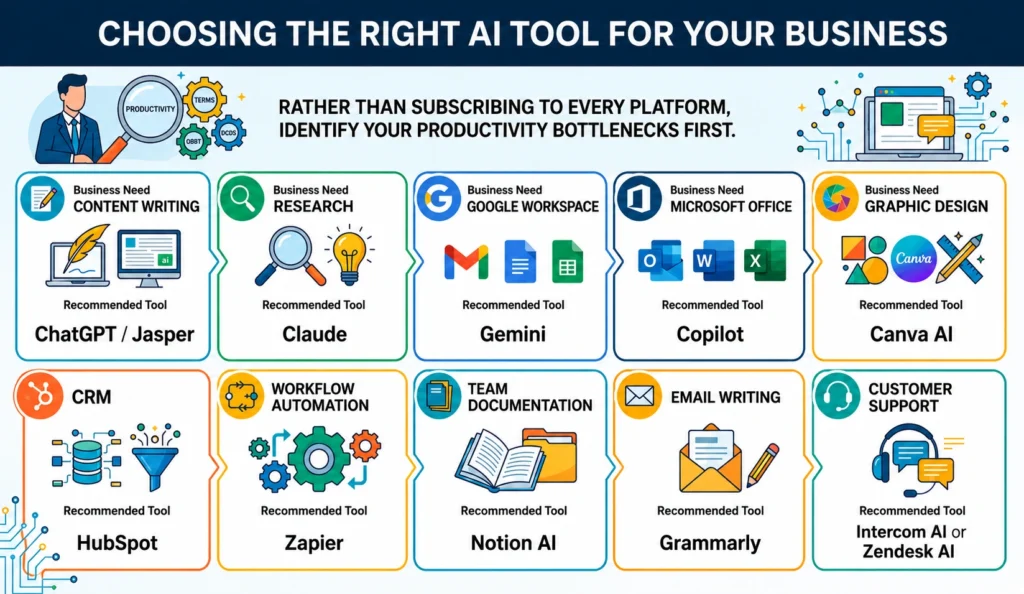
Rather than subscribing to every platform, businesses should first identify their biggest productivity bottlenecks.

Common Mistakes When Using AI
Many businesses expect AI to produce perfect results immediately. In practice, AI performs best when used as a collaborative assistant rather than a replacement for human judgment.
Avoid these mistakes:
- Publishing AI-generated content without fact-checking
- Sharing sensitive customer information with AI tools without reviewing privacy policies
- Ignoring human editing
- Choosing tools based solely on popularity instead of business needs
- Paying for overlapping subscriptions
Future of AI for Small Businesses
AI is expected to become even more integrated into everyday business software. Instead of opening separate AI applications, businesses will increasingly access AI directly within email platforms, accounting software, CRM systems, and productivity suites.
Emerging trends include:
- AI agents capable of completing multi-step business tasks
- Personalized customer interactions
- Predictive sales analytics
- Automated financial reporting
- AI-assisted hiring and HR management
- Industry-specific AI assistants
Small businesses that learn how to combine human expertise with AI are likely to gain efficiency advantages without significantly increasing operational costs.
Final Thoughts
AI has become an accessible productivity tool for businesses of all sizes. The best solution depends on your existing software ecosystem, budget, and business goals rather than simply selecting the most popular platform.
For many small businesses, starting with one or two carefully chosen AI tools can deliver measurable improvements in efficiency, communication, and customer service. As your needs evolve, additional specialized tools can be introduced gradually to build a sustainable AI-powered workflow.
Frequently Asked Questions
What is the best free AI tool for small businesses?
ChatGPT, Google Gemini, Canva AI, and Grammarly all offer free plans that are suitable for many small business tasks, although advanced features typically require paid subscriptions.
Which AI tool is best for marketing?
Jasper, ChatGPT, and Canva AI are among the most popular options for content creation, advertising, and social media marketing.
Is AI safe for business use?
Most reputable AI providers implement security measures, but businesses should avoid uploading confidential information without understanding the provider’s privacy and data handling policies.
Can AI replace employees?
AI is generally more effective at automating repetitive tasks than replacing human expertise. Many businesses use AI to enhance employee productivity rather than reduce staffing.


Shruti Singh is a passionate writer having 6 years of writing and editing experience. Through her articles on news2world, she explores the connection between people, planet, and everyday choices, translating complex information and issues into clear, engaging, and practical insights. Her work aims to inspire readers to adopt eco-friendly habits, think critically, and contribute meaningfully to a more comfortable future.


